

In humanoid robots, actuators directly determine how joints move and how much torque they can generate. They are among the most numerous and expensive core components in the entire robot.
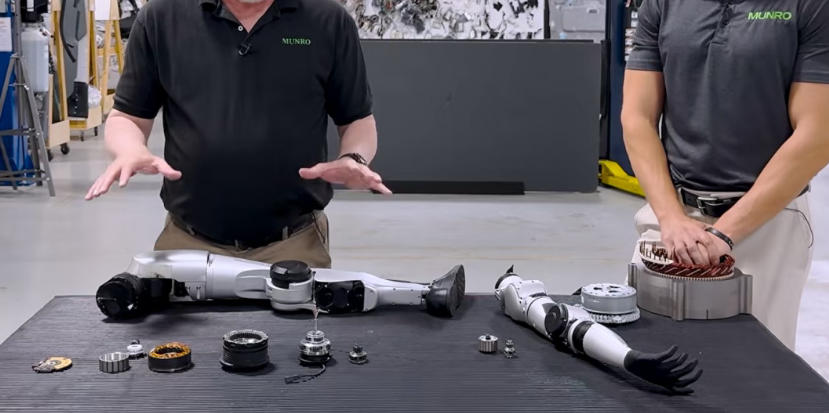
Recently, Munro Live conducted a detailed teardown of the actuators used in the Unitree G1 humanoid robot, examining everything from the motor and two-stage planetary gearbox to the control board, bearings, and internal wiring.
The real value of this teardown is not simply identifying the components used. Instead, it reveals a much bigger engineering challenge: how to balance torque, gear reduction, heat dissipation, control accuracy, structural strength, and manufacturing cost within an extremely limited joint space.
1. Overall Architecture: 23 Actuators, One Design Concept, Different Sizes
The Unitree G1 examined by Munro reportedly contains approximately 23–24 actuators, with higher-specification versions potentially featuring additional units.
With so many actuators in one robot, costs accumulate quickly. Therefore, actuator design and cost optimization directly affect whether humanoid robots can achieve commercial-scale production.
Interestingly, Unitree does not simply replicate one actuator specification across all joints.
The teardown reveals that the legs use larger actuators, while the arms use smaller versions based on a similar structural design. This is because the hip and knee joints must generate high torque within limited installation space, whereas the shoulder and elbow joints have tighter dimensional constraints and generally require less torque.
Another interesting design choice is how Unitree adjusts motor performance.
Even when motor diameters are similar, torque can be increased by changing the axial stack length (the length of the stator core). Some smaller motors gain additional torque simply by increasing their height by a few millimeters. Similar compact actuators are also used for foot drive mechanisms inside the lower legs.
When motor diameter is restricted by installation space, increasing axial length to obtain more torque is a practical engineering solution.
2. The Motor: Why Use a 16-Pole, 18-Slot Configuration with Concentrated Windings?
At the heart of the actuator is an inner-rotor motor.
The rotor is located inside and contains 16 permanent magnets, forming a 16-pole configuration. The stator has 18 teeth and 18 slots.
The windings are tightly wrapped around individual stator teeth, forming a typical concentrated winding configuration.
The first advantage of concentrated windings is space efficiency.
Since the wire is wound directly around individual teeth, it does not need to span multiple slots as it does in distributed winding configurations. This significantly reduces the winding end-turn length extending beyond the stator core, helping minimize the motor's axial dimensions.
For an actuator installed inside a humanoid robot joint, this space-saving advantage is particularly important.
However, there is a trade-off.
The combination of 18 slots and 16 poles produces relatively significant magnetic harmonics, resulting in a less sinusoidal magnetic waveform compared with conventional automotive traction motors.
Automotive traction motors often use more slots and distributed windings to achieve lower losses and smoother electromagnetic performance. However, these configurations generally require longer end turns and more axial space.
Unitree's design prioritizes maximizing torque within the smallest possible space, even if it means accepting certain efficiency trade-offs.
This highlights a fundamental difference between humanoid robot joint motors and electric vehicle traction motors: their design priorities are not the same.
Why choose an inner-rotor motor?
Thermal management is one important reason.
An outer-rotor motor can generate higher torque by placing the air gap at a larger radius. However, its windings are enclosed inside the rotor structure, making heat dissipation more challenging.
In the G1 design, the stator and windings are positioned on the outside. The outer surface of the stator is tightly connected to an anodized aluminum structural component, which helps transfer heat away from the windings.
The aluminum housing also features raised surface structures to increase the available heat dissipation area. Additional aluminum components clamp the assembly together, creating a direct thermal conduction path.
According to industry media reports covering the Munro teardown, the team also identified copper heat pipes attached to the high-duty-cycle knee actuators. These operate on a principle similar to the heat pipes used in computer processors.
Meanwhile, two centrifugal fans are positioned near the hip area, directing airflow through machined channels across the actuators.
In other words, Unitree does not treat the motor as an isolated component. Instead, the robot's structural components actively participate in the overall thermal management system.
3. Integrating the First-Stage Planetary Gearbox Inside the Motor
One of the most interesting engineering features of the G1 actuator is how efficiently it utilizes the internal motor space.
The motor's stator and rotor are relatively thin, leaving a hollow, donut-shaped space in the center.
Unitree takes advantage of this unused space by integrating the first-stage planetary reduction mechanism directly inside the motor.
The inner side of the rotor connects to the sun gear of the first-stage planetary gear set. The first reduction stage increases torque inside the motor, while the second planetary stage is positioned immediately next to the motor and uses larger gears to handle the increased output torque.
According to the teardown video, the total reduction ratio of this two-stage planetary gearbox is approximately It is worth noting that publicly available teardown figures may vary depending on the actuator version and joint configuration.
By utilizing the hollow space inside the motor, Unitree effectively turns previously unused internal volume into gearbox installation space, significantly reducing the overall axial length of the actuator.
Why not use a single-stage planetary gearbox?
A reduction ratio of 7.77:1 is not particularly high, and theoretically, a single-stage planetary gearbox could achieve a similar ratio.
However, Munro's explanation focuses on gear meshing geometry.
When a single stage is responsible for a relatively large reduction ratio, the gear engagement geometry becomes less favorable, potentially increasing friction, mechanical losses, and wear.
By distributing the reduction across two stages, each stage operates at a more manageable ratio, allowing for more reasonable design margins.
For applications requiring much higher reduction ratios, such as 20:1 or 50:1, harmonic drives or cycloidal reducers may be more suitable.
However, planetary gearboxes offer several advantages at lower reduction ratios, including:
- High transmission efficiency.
- Good backdrivability.
- Relatively compact mechanical construction.
- The ability to recover energy during reverse torque conditions.
For example, when a robot lands or experiences an external force, the joint may generate negative torque. The motor can then operate as a generator, potentially recovering energy.
4. Control, Sensing, and Wiring: The Often-Overlooked Integration Challenges
High integration is not limited to mechanical design.
Inside the actuator is a compact circular control board that integrates the inverter and motor control functions.
Six power switches form a three-phase inverter, converting DC power from the battery into three-phase AC power to drive the motor. Under peak load conditions, the system must handle currents exceeding 100A.
The controller receives torque commands from the upper-level control system, converts them into current commands, and controls the switching sequence of the power devices.
All of this depends on accurately knowing the rotor position in real time.
However, rotor position is not necessarily the same as the actual output position of the joint.
Between the motor and the final output shaft are two stages of gears, each of which introduces some degree of backlash.
Therefore, knowing only the motor's rotor angle is insufficient to determine the exact position of the output shaft.
To address this issue, the G1 includes an additional position-sensing mechanism connected to the output shaft. This provides direct feedback on the actual output position, creating a closed-loop control system integrating the motor, gearbox, position sensor, and controller.
The importance of the integrated output bearing
Another noteworthy component is the large-diameter output bearing.
It is positioned around the outer diameter of the final-stage planetary carrier. Besides supporting rotational movement, it must also withstand off-axis loads generated during robot operation.
For example, when a robot arm holds an object, the load may act at a distance from the rotational axis. This creates a bending moment that is ultimately transferred to the bearing.
Integrating the bearing directly into the actuator eliminates the need for separate external bearings and additional support structures.
Furthermore, the difference between single-sided support and fork-shaped double-sided support can significantly affect how the bearing handles off-axis loads.
Wiring: A Small Detail with Major Engineering Implications
Wiring is another easily overlooked challenge.
If all 24 actuators independently connected to the battery through separate power cables, the robot's wiring system would quickly become complicated and difficult to manage.
Unitree addresses this by routing power and signal cables through the center of the actuators and connecting adjacent actuators in a daisy-chain topology.
However, these cables must repeatedly twist as the robot's joints move.
Solid, thick conductors are more vulnerable to fatigue under repeated bending and twisting. Therefore, the design uses multiple fine-stranded wires, organized into separate insulated cable bundles.
Based on Munro's experience-based estimates, the expected cycle life of this wiring arrangement is in the hundreds of thousands of cycles.
For industrial applications requiring millions of operating cycles, more advanced solutions, such as spiral cable systems similar to automotive steering-wheel clock springs, may be necessary.
However, such solutions would introduce additional components and increase manufacturing costs.
An Actuator Is Much More Than a Combination of Components
At the end of the teardown, Munro also discussed the challenges of scaling actuator manufacturing.
At present, these actuators are reportedly still being produced at relatively small volumes, typically in the thousands, with many suppliers manufacturing customized versions for individual customers.
Different robots and even different joints within the same robot may use slightly different actuator designs, directly increasing production costs.
If humanoid robots are to reach mass-production volumes of hundreds of thousands or even millions of units, their design philosophy will inevitably need to change.
Manufacturers will need to reduce customization, simplify system architecture and assembly processes, and adopt more mature manufacturing methods from the automotive industry.
This brings us back to the central message of this teardown:
An actuator is not simply a combination of a motor, gearbox, bearing, and controller. It is the result of continuous engineering trade-offs between torque, size, efficiency, heat dissipation, service life, and manufacturing cost.
As concentrated windings and segmented stator structures become increasingly important in humanoid robot joint motors, fundamental manufacturing capabilities will become even more critical.
The ability to consistently and precisely wind a single stator tooth may become an increasingly important factor in determining the overall performance and manufacturing cost of humanoid robots.
Ultimately, advanced robot technology still depends on fundamental manufacturing processes. The precision and consistency of motor winding are among the foundations that make these highly integrated actuators possible.